Plumbing Truck Stock List: Build It From Invoices, Not a Blog
Generic plumbing truck stock lists miss your local work. Build yours from two months of invoices, set one layout per truck, and load from the phone call.
A generic truck stock list can be wrong for your town
Search for a plumbing truck stock list and you get long lists of fittings, valves and tools. That does not make the list useful.
Al Schwartz, a retired third generation master plumber who founded shops in Shirley, New York, and Phoenix, wrote in Contractor magazine that any stock list is “generic and extremely so.” He put the local problem plainly: “A stock list for a service truck for a shop on Long Island would be almost useless to a shop in South Texas.”
A Nassau County truck may carry more copper drain pipe and brass. A truck working ranch country outside Houston may need more pumping, compressed air and industrial parts. Local codes, local customs and the systems installed in your area decide what belongs on your truck.
The useful list is sitting in your invoices.
Two months of invoices will show what belongs on the truck
Al Levi, an operations consultant writing in Plumbing & Mechanical, recommends pulling two months of invoices from peak season. If you track usage by truck or technician, use that data too.
Sort every part into two groups:
- Absolutely needs
- Nice to have
The first group gets space on the truck. The second group waits until the numbers support it.
Levi’s target is to arrive with “80 percent of what you need 80 percent of the time.” That is a stocking target, not a measured result. It gives you a useful standard without pretending your first list will be perfect.
Overstocking ties up money. Parts can get damaged or go out of warranty while they sit on the shelf. Understocking costs sales. As Levi wrote, “Time wasted chasing parts is a killer and can result in a lost sale!”
For a one person shop, stock what you can afford. When you can, buy two of a part and build the stock slowly. Always carry fittings, pipe and valves. Keep basic consumables such as flux, solder, glues and primers on the list too.
Your own numbers should also drive the price list you use with customers. Build that price list from your own numbers, not from a generic template copied from another shop.
Check these emergency items against your invoices
A short emergency checklist can expose gaps in your current stock. It is not a universal list. Check each item against the calls you actually run.
Look for:
- Water solidifier for pulling a toilet or draining a failed water heater
- Fast set cement
- Epoxy putty for a temporary fix
- Extra toilet flanges and wax rings
- Mechanical test plugs
- Gloves and safety glasses
- A small inspection camera
- Plenty of buckets
When you replace a toilet flange, you need to replace the wax gasket. That makes extra flanges and wax rings a practical invoice check, especially if those calls show up in your two month pull.
The goal is not to fill every open space. It is to carry the parts that prevent a second trip on the calls your shop actually gets.
The same part should live in the same place on every truck
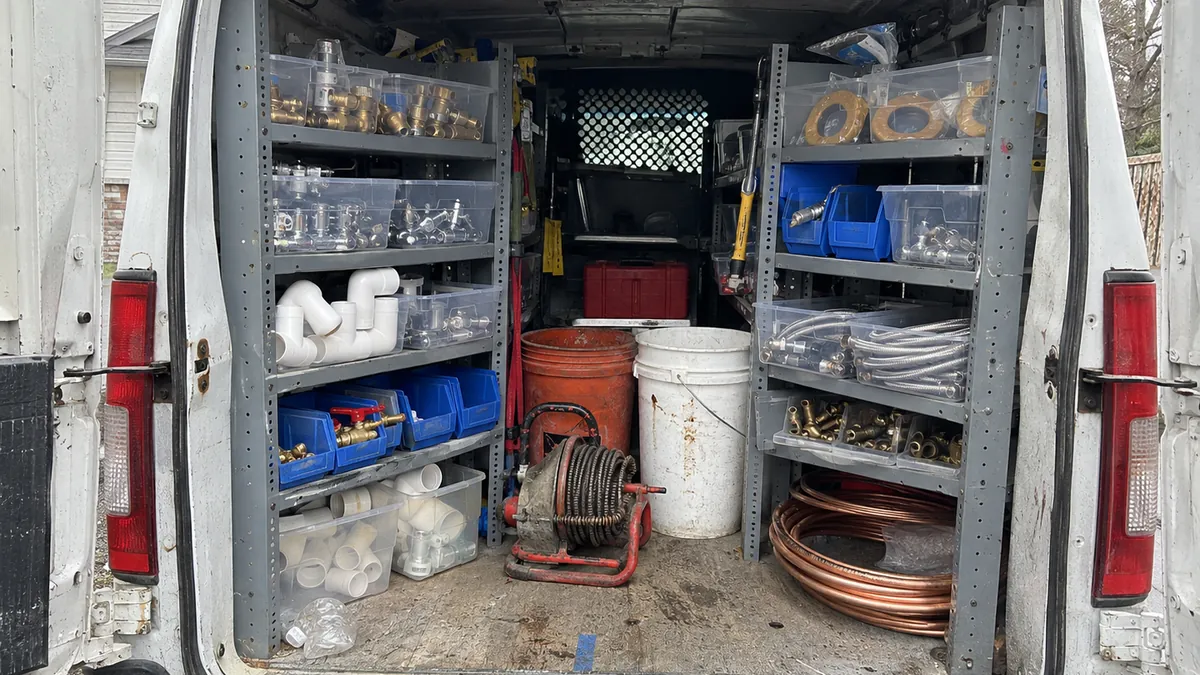
Levi recommends putting the heaviest items low and keeping the biggest movers at eye to hip level, like supermarket shelving. Use the same layout on every truck.
Label the locations. “Column A Row 2” is enough. A technician should know where to look even when working from a different truck.
Then put the numbered stock list on a clipboard at the back door. Keep a pen on a chain. The technician writes down every part as it leaves the truck. That list becomes the restock order.
This also gives you a way to find waste. Schwartz wrote, “Inventory is money. Treat it accordingly.” He also warned that “A sloppy journeyman can destroy more material than he sells.” A fixed layout and a written restock list make missing material visible.
The phone call decides what needs to be loaded
Truck stock matters most on calls you take on the fly. Schwartz’s advice is simple: ask good questions on the phone so you can pick up missing material before you go.
A pattern shows up again and again in call summaries. A caller says, “the toilet upstairs keeps running.” Or, when asked, the caller reads the brand, gallon size and gas or electric information from the water heater label.
With that detail on the summary before the truck leaves, the technician knows whether it is a fill valve and flapper job or a water heater job. The truck can be loaded accordingly.
A caller who only hears “we’ll call you back” never gets asked. The technician arrives guessing.
Use these intake questions before the truck rolls. For water heater calls, use the questions that identify the unit before you quote. If the customer already bought the part, ask about that too. Customer supplied parts create their own problems.
Bella, Plumber Secretary’s phone secretary, answers every call around the clock. She asks what is wrong, which fixture is involved, the brand and size from the label, and the address. She sends a call summary by text or email.
Plumber Secretary is $95 per month for the Professional System, or $149 per month with the AI secretary and a website built for you. You can hear Bella on the demo line or call (669) 284-5564. The main phone number is (707) 620-5284.
Pull the invoices and rebuild the list this week
Pull two months of peak season invoices. Sort the parts into absolutely needs and nice to have. Compare the emergency items against those invoices. Set the same layout on every truck, label each location and put the numbered list on a clipboard at the back door.
Then change the phone intake. Ask for the fixture, the brand, the size from the label and the address before the truck rolls.
That is the difference between carrying a long list and carrying the right stock.