Techs Drive the Van Home? What the IRS Wants in Writing
If a tech commutes in your work van, the IRS puts a value on that drive. Learn the $1.50 rule, what makes a van qualify, and what a take-home policy should say.
TL;DR: The IRS values an employee’s commute in an employer vehicle at $1.50 each way, unless the van qualifies as a qualified nonpersonal use vehicle. Put the take-home rules in writing, then ask your accountant how the commute belongs on payroll.
A tech’s commute is worth $1.50 each way
If you provide a van for business and require a tech to drive it between home and work, IRS Publication 15-B says the commute has a taxable value. Multiply each one-way trip by $1.50.
That means two one-way trips are $3.00 per day. Over 250 workdays, the illustrative value is $750 per tech per year. The amount must be included in the employee’s wages or reimbursed by the employee.
There is one major exception. A vehicle that qualifies as a “qualified nonpersonal use vehicle” can be treated as a working condition benefit, so no wages are added. An ordinary plumbing van or pickup does not qualify automatically.
You also need a written policy. The policy must limit use to commuting, with only de minimis personal use allowed. The employee must follow it. This is general information from the IRS guide, not tax advice, so confirm the details with your accountant or payroll provider.
The IRS rule depends on what you put in writing
The commuting rule applies when you provide the vehicle for business and require the employee to commute in it for bona fide noncompensatory business reasons. Your written policy cannot allow personal use beyond commuting or a minimal personal stop. The employee has to follow that policy.
The IRS gives a simple de minimis example: a stop for a personal errand while traveling between a business delivery and the employee’s home. That does not turn the van into a personal vehicle.
“Just this once” also has a limit. The IRS says commuting use more than one day a month is not excludable as a de minimis benefit.
If the vehicle is a four-wheeled automobile, which includes cars, pickup trucks, and vans, the employee cannot be a control employee for this rule to apply. For 2026, a control employee at a nongovernment employer generally includes a director, an officer paid $145,000 or more, an employee paid $290,000 or more, or someone with 1% or greater ownership.
If you own the shop, you are generally a control employee. Ask your accountant how that applies to your own commute.
A regular crew cab with a toolbox usually does not qualify
A qualified nonpersonal use vehicle is designed so an employee is unlikely to use it for more than minimal personal purposes.
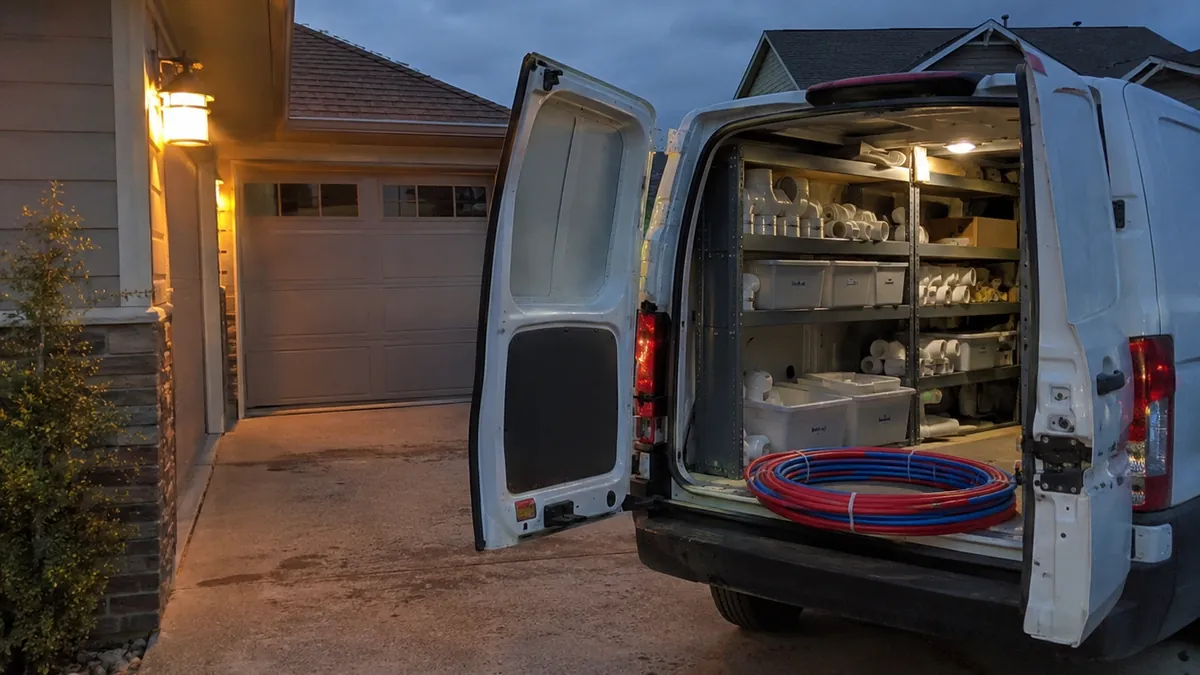
For a van, IRS Publication 15-B says it must have permanent business markings, such as decals, paint, or advertising. It must have a seat for the driver only, or for the driver and one other person. It must also have permanent shelving that fills most of the cargo area, or an open cargo area that always carries business merchandise, materials, or equipment.
A regular crew-cab pickup with a toolbox in the bed does not meet that test. A marked cargo van with permanent shelving and two front seats might. Have your accountant confirm the vehicle classification before you leave the commute value off payroll. In California, the lettering on that van has its own rule too: see what a C-36 plumber must show on each side of a commercial vehicle.
Pickups face their own test. They must be specially modified and clearly marked, with features such as a hydraulic lift gate, permanent tanks or drums, permanent side boards that materially raise the bed sides, or heavy equipment such as a generator, welder, boom, or crane.
Owners still split on whether vans should go home
The tax rule does not decide whether take-home vans are good business. Owners disagree. The sources below are older and come from the HVAC side of the trades, but the trade-offs carry over.
An ACCA blog post from February 29, 2012, titled “Should Techs Take Trucks Home?”, says contractors “just can’t seem to agree” on whether techs should take trucks home or return them nightly. The author describes one company with about 40 vehicles that switched to take-home vans. Most customers were reachable in under 30 minutes when dispatched from home, and fuel costs fell 50 percent. GPS was used in the fleet.
The problems were restocking trucks and getting invoices and payments back to the office. An attempt to have techs mail invoices daily failed. The company eventually hired a full-time parts driver to deliver parts to each tech’s home every day. The same author describes a smaller company with about 15 vehicles that returned trucks to the shop nightly. There is no single right answer.
An ACHR News article from November 9, 2015, quotes Mark Flock, president of Flock’s Heating and Air Conditioning in Cashton, Wisconsin. His techs worked in a rural area. He said techs lose the benefit of taking vehicles home if they do not take care of them, and said it had not been a problem for his company.
Dale found out why a verbal rule is not a policy
We’ll call him Dale. He runs a four-truck shop. He is a composite, not a real customer. Dale let his techs take the vans home because it saved the morning shop stop, and he never wrote a policy. One tech used the van for a grocery errand and a family trip, and Dale had nothing in writing to point to. The argument was no longer about convenience. It was about what use had actually been allowed.
Put these ten points on one page
Your take-home van policy should say:
- Who gets to take a van home.
- That use is for commuting only.
- That personal errands are prohibited except for a minimal stop on the way home from a business call.
- That passengers and family use are not allowed.
- Who pays for fuel.
- Where the van parks, such as a secure garage or driveway. Check whether your homeowners association restricts lettered trucks.
- How invoices, payments, and used parts get back to the office.
- How the van gets restocked.
- What conduct or missed duties cause the privilege to end.
- Whether the commute value is added to wages or reimbursed.
If techs take vans home during on-call weeks, read our guide to on-call pay, standby, and callout rotation. For the calls themselves, see how to stop losing after-hours plumbing calls and what your answering service should actually do.
For a van that never returns to the shop, use this plumbing truck stock list built from invoices. Also ask your insurance agent whether your commercial auto policy lists the drivers and covers the van overnight at the tech’s home. Start with what insurance a plumbing business needs. Do not assume. Ask.
Bella, from Plumber Secretary, answers a shop’s phone 24 hours a day, asks what is wrong and where, then sends the owner a call summary by text or email. Take-home vans make after-hours calls faster to answer, and Bella sends the summary the tech needs before pulling out of the driveway. She does not dispatch trucks or track vans. Hear the demo line at (669) 284-5564. The main number is (707) 620-5284.
This week, write the one-page policy. Ask your accountant two questions: does the commute value belong on wages, and does your van meet the qualified nonpersonal use test? Then call your insurance agent.