Customer Memory: The Feature That Builds Repeat Business
When a customer calls back and you already know their name, address, and last job, they don't call anyone else next time. Here's how memory changes everything.
Here’s a scenario every plumber knows. Mrs. Johnson calls in March about a dripping kitchen faucet. You go out, replace the cartridge, leave your card. Three months later she calls back. New issue, same house.
If your secretary or answering service treats that call like a brand new customer, asking for her name, address, and the whole intake from scratch, something breaks. The customer feels like she doesn’t matter. Like she’s just another ticket.
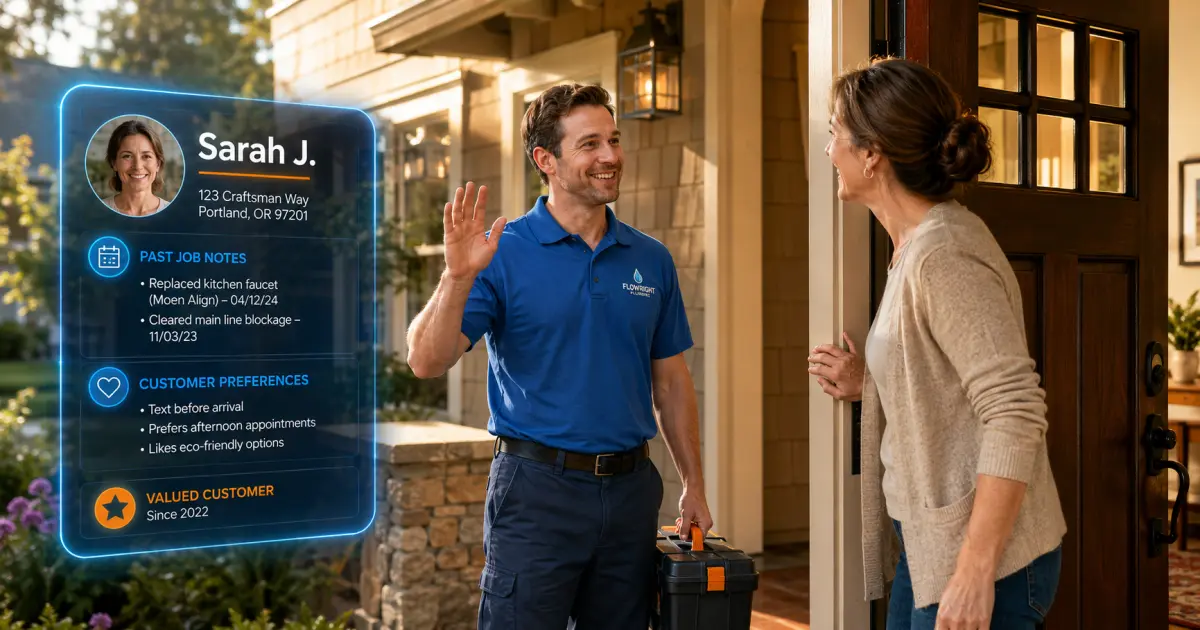
Now imagine the opposite. She calls, says “Hi, it’s Sarah Johnson,” and the person answering says, “Hi Sarah, good to hear from you. Is this about the kitchen faucet at 42 Oak Street, or something new?”
That’s a completely different experience. That’s how you get five-star reviews, referrals, and a customer who never calls anyone else.
Why most answering services can’t do this
Call centers cycle through operators. The person who took the first call is never the same person who takes the second one. There’s no continuity, no memory, no relationship.
Generic phone bots are even worse. They have no concept of who called before. Every call is isolated. Every caller is a stranger.
The only person who traditionally had this kind of memory was you or your office manager. And you can only remember so many customers, especially when you’re running from job to job.
What customer memory actually means
Real customer memory means the answering system stores every interaction tied to the caller’s phone number:
- Name and address. So they never have to repeat it.
- Past jobs. What was done, when, and at which property.
- Past quotes. If you quoted a water heater replacement last month, that context is right there.
- Property details. Two-story house, slab foundation, crawl space access, gate code. Saved from the first visit.
- Preferences. Morning appointments only. Has dogs. Prefers text over calls.
When that customer calls back, all of that context is immediately available. The call is shorter, more accurate, and the customer feels valued.
How it changes the numbers
Repeat customers are the backbone of every successful plumbing business. They cost nothing to acquire. They already trust you. They accept your pricing without shopping around. And they send referrals.
The thing that turns a one-time job into a repeat customer is the feeling that you remember them. That they’re not starting from zero every time they call.
Shops that track customer history and personalize the follow-up experience see measurably higher repeat booking rates. It’s not a small difference. It’s the difference between a customer who calls you by default and one who Googles “plumber near me” every time.
The review effect
When a customer calls back and hears, “Hi Sarah, is this about the Oak Street property?” she tells her neighbor. She leaves a review that says “they always remember me.” That review generates more calls than any ad you could run.
Reviews that mention personal service, memory, and being treated well rank higher and convert better than generic five-star reviews that just say “great service.”
How it works in practice
The phone rings. The system sees the caller’s number. Pulls up their history. Greets them by name. Asks if this is about the same property or something new. Adjusts the intake based on what’s already on file.
If it’s a new issue at the same address, the address and access details are already captured. The call takes half the time. If it’s a different property, it starts a fresh intake but keeps the customer profile linked.
After the call, you get a summary that includes the new issue plus the relevant history. “Sarah Johnson, 42 Oak Street. Last visit March 2026, kitchen faucet cartridge replacement. New issue: bathroom toilet running. Requested morning appointment.”
You show up knowing exactly who you’re seeing, what you did last time, and what to expect.
Not just a nice-to-have
Memory isn’t a gimmick. It’s the single biggest advantage a small plumbing shop can have over the bigger companies. The big outfits have trucks and marketing budgets, but they treat every call like a transaction. You can treat every call like a relationship.
That’s what keeps customers coming back. That’s what generates the kind of reviews that actually bring in new business. And that’s what most answering services completely miss.